
AI Won't Replace You. But It Might Give You Your Tuesdays Back.
Let's get the awkward part out of the way.
You've been hearing about AI for small business for two years now, and somewhere in there it stopped feeling exciting and started feeling like homework. Another tool. Another login. Another thing the internet insists you're already behind on.
We see you. The to-do list does not need a new item called "figure out AI" sitting at the bottom, glaring up at you.
So let's not do that.
Instead, let's ask a better question than the one everybody's shouting. Not "how do I keep up with AI?" The better question is: what is the most boring, repetitive, soul-draining hour of your week, and could a machine do it so you don't have to?
That's it. That's the whole strategy.
This is not a fad you can wait out
We'd love to tell you that you can ignore this and be fine. We can't, and we don't lie to you here.
The Small Business and Entrepreneurship Council ran a tech survey in 2026 and found that 82% of small business employers have already invested in AI tools. The typical small business is now running about five of them. Not enterprises with a tech department. Small shops. Owner-operators. People exactly like you.
So the playing field already shifted. The good news, and it's genuinely good news, is that the cost of entry fell through the floor. The tools no longer require a coder, a budget, or a six-month rollout. Most of them have a free tier and a plain-English setup you could finish before lunch.
Which means the question isn't really whether anymore. It's where to point it first.
Point it at the leak, not the shiny thing
Here's where most owners go wrong: They chase the flashiest tech demo instead of the most expensive leak in their boat.
The highest-return move is always the one tied to lost money or wasted owner time. The inbox that doesn't get answered until 9 PM. The lead that goes cold because nobody followed up. The same five customer questions you answer by hand, every single day, like it's your job. (It is not your job.)
Start there. One workflow. The one painful, repetitive thing you do every day that follows the same predictable pattern.
Automate that one thing. Measure what it gives back. Then add the next one.
That's how you build what actually works: not a pile of subscriptions you feel guilty about, but a lean tech stack that quietly hands you back two or three hours a day. Hours you can spend on the strategic work only you can do. Or, and we mean this, hours you can spend at home with the people you started this whole thing for.
Dr. Gena Lester, who spoke at our last summit, has a phrase for it: "Scale lean. Build your robot workforce. Reclaim your time." The robots aren't here to take your team's jobs. They're here to take the busywork nobody should be doing in the first place so you can fix your business bottleneck.
The part that should actually relieve you
Now, for the faith-driven owner, there's usually a deeper hesitation under the logistics. It's not "is AI hard." It's "does leaning on this make my business less human, less personal, less mine?"
That's a good instinct. Hold onto it. And then hear the actual answer.
The same research everyone's citing about AI adoption keeps surfacing a second finding that nobody puts on the billboard. LinkedIn's 2026 small business research found that owners believe real human voices matter more than ever, and that human relationships are becoming a bigger competitive edge, not a smaller one.
Read that twice. In the age of the machine, the human stuff went up in value.
Brad Ball said it best from our stage: "Everyone has access to the same AI. But not everyone has a story worth telling."
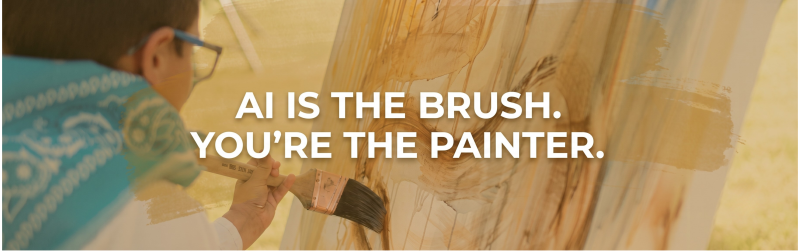
And then the line we keep coming back to: "AI is the brush. You're the painter."
The brush got really, really good. That doesn't make the painter optional. It makes the painter the entire point. Anybody can generate a passable email now. Nobody else can tell your story, sit with your customer, make the values call, or look an employee in the eye and mean it.
The golden rule: Automate the busywork, never the relationship
So here's the rule that keeps you on solid ground: Automate the repetitive tasks, never the relationship.
Let AI write the appointment reminder. You write the note that matters.
Let AI sort the inbox. You make the call that needs a human heart on the other end.
Let the robot handle the repeatable, so you have margin left over for the irreplaceable.
That's not compromising your values to keep up. That's true stewardship of your time so the human moments get the best of you instead of the leftovers. It's how you shift away from running an owner-dependent business and start building a self-sustaining asset.
What this looks like on a normal week
Forget the trillion-dollar economy headlines for a second. Here's the ground-level version.
A customer fills out your form at 11pm. Instead of that lead sitting cold until you surface tomorrow afternoon, an assistant answers the basic question, captures their info, and books the follow-up while you're asleep. You wake up to a warm lead instead of a missed one.
The same five FAQs that used to eat your mornings get handled before they reach you. The meeting you recorded turns itself into a clean list of who-owes-what-by-when in about ten seconds, instead of the forty-five minutes you used to lose to it.
None of that is futuristic. People are doing every bit of it right now, this week, for the price of a couple of streaming subscriptions.
The owners pulling ahead in 2026 aren't the ones with the fanciest tools. They're the ones who quietly handed the busywork to a machine and used the reclaimed time to do more of what actually grows a business: build relationships, tell the story, lead the people.
The honest catch
We're not going to pretend it's all upside, because that's not how we talk to you.
There's a real temptation here, and it's worth naming. The same tool that frees up your Tuesday can just as easily get pointed at filling that Tuesday with more. More output, more volume, more hustle, until you've automated your way into being busier than before.
That's not stability. That's the old trap with a faster engine.
So decide now what the reclaimed time is for. If AI hands you back ten hours a month and all ten go straight back into the grind, you didn't get scale. You got a treadmill with a better motor.
Reclaim the time. Then actually keep it.
So, where do you start?
Not with a strategy document. With a single annoying hour.
Pick the most repetitive, predictable, draining task on your plate this week. Hand that one thing to a tool. See what comes back.
The brush is sitting right there, and it's never been cheaper to pick up. But you're still the painter. Don't ever let anyone, or anything, convince you to put the brush down and walk away from the canvas.
This is exactly the kind of thing we work through together at Scale with Stability: not "AI for the sake of AI," but using the right frameworks to buy back margin so your faith, your family, and your best work get the real you, not the burned-out one.
Come learn it in a room full of owners figuring it out alongside you. We'll save you a seat.


